
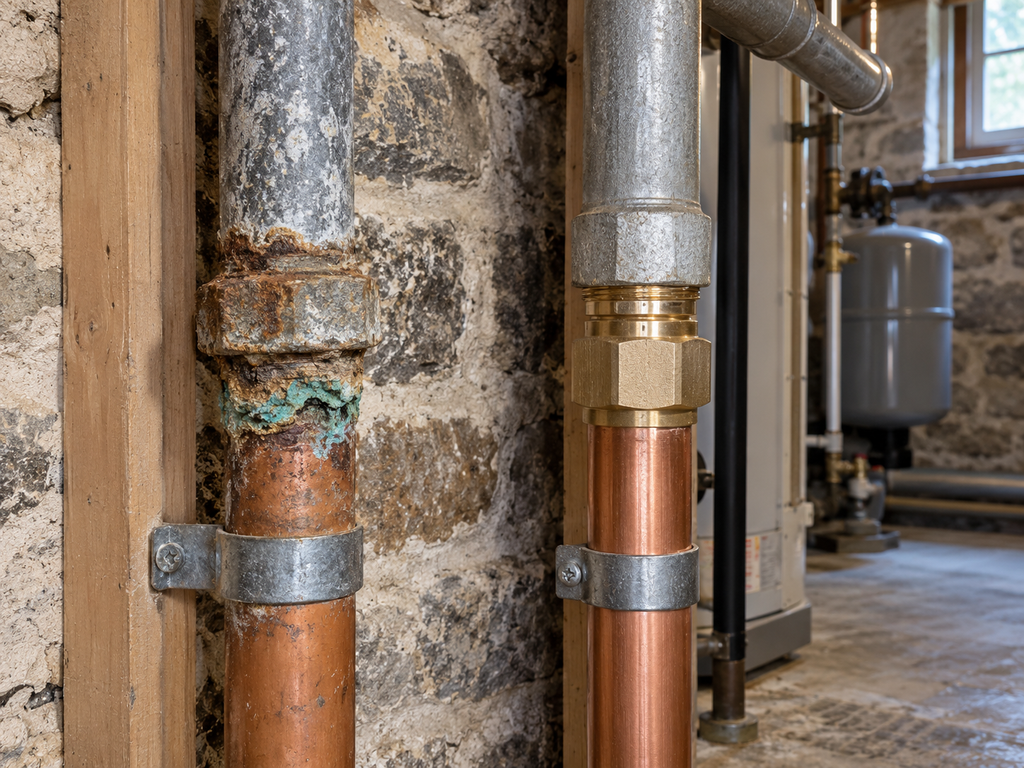
Older homes often contain generations of plumbing repairs, including places where newer copper connects to galvanized steel. When dissimilar metals are joined without an appropriate transition, corrosion can accelerate at the connection and eventually restrict flow or create a leak. For homeowners in Center City, Point Breeze, Ardmore, and Main Line, this is the kind of detail that can decide whether a renovation or repair remains durable after the visible finish is complete.
The primary search intent behind copper galvanized pipe corrosion Philadelphia is practical: understand what the condition means, what should be checked before work proceeds, and how to avoid closing the assembly before the real cause is understood. The goal is not to over-complicate the project; it is to make the scope match the condition that is actually present.
What Homeowners Usually Notice
The visible symptom is only one part of the decision. A contractor also needs to understand rust, green staining, or mineral buildup at mixed-metal joints, threaded galvanized pipe condition beyond the visible fitting, and how those findings affect the surrounding work. Resolving those questions before finish work protects the new materials and helps keep a localized detail from turning into avoidable rework later.
How Contractors Diagnose the Condition
A professional review typically includes:
- Rust, green staining, or mineral buildup at mixed-metal joints
- Threaded galvanized pipe condition beyond the visible fitting
- Evidence of reduced internal diameter or poor flow
- Whether the connection uses an appropriate dielectric or approved transition method
Planning the Repair or Remodel
Repair planning should look beyond the single corroded fitting. If several transitions are deteriorating or nearby galvanized pipe is heavily scaled internally, replacing a short coupling alone may not address the larger service problem. The best result comes from coordinating the hidden construction with the finish requirements so one trade is not forced to undo another trade’s completed work.
This is where a focused commercial service page should receive the strongest internal support. Learn more about plumbing services and how the broader project can be coordinated around the condition described here.
What to Avoid
Cleaning the outside of a corroded joint does not restore the metal that has already been lost. Rebuilding the connection with another incompatible fitting can restart the same failure mechanism. A strong scope separates a cosmetic correction from work that affects performance, access, drainage, structure, or serviceability.
When Additional Evaluation Makes Sense
Active leakage, severely thinned pipe, or widespread galvanized deterioration can justify a broader repipe discussion based on the actual system condition. That decision should be made before the area is covered, painted, tiled, sided, or otherwise treated as complete.
Reference: Pennsylvania Uniform Construction Code. Requirements and field conditions vary by project, so the applicable authority and project-specific professionals should guide final decisions.
Plan the Next Step
Philadelphia Plumbing Experts can inspect the existing piping and fixtures, identify whether the problem is localized or system-wide, and recommend a repair or installation scope that matches the actual condition.