
Most homeowners rarely touch the main water shutoff valve.
It may remain in one position for years—sometimes decades—until a plumbing leak suddenly requires the entire house to be isolated.
That is the worst time to discover that the valve is frozen, heavily corroded, leaking around the stem, or unable to stop the water completely.
Older Philadelphia houses can contain multiple generations of water piping and valve types, making the condition of the primary shutoff worth understanding before an emergency occurs.
What the Main Shutoff Does
The main interior shutoff controls water entering the house after the service connection.
Closing it allows plumbing work to occur without keeping the entire domestic water system pressurized.
The exact location varies.
In many Philadelphia rowhomes, the valve may be in the basement near the front foundation wall, meter area, or point where the water service enters the building.
Philadelphia Plumbing Experts provides plumbing repair and pipe services for supply-system problems and shutoff conditions.
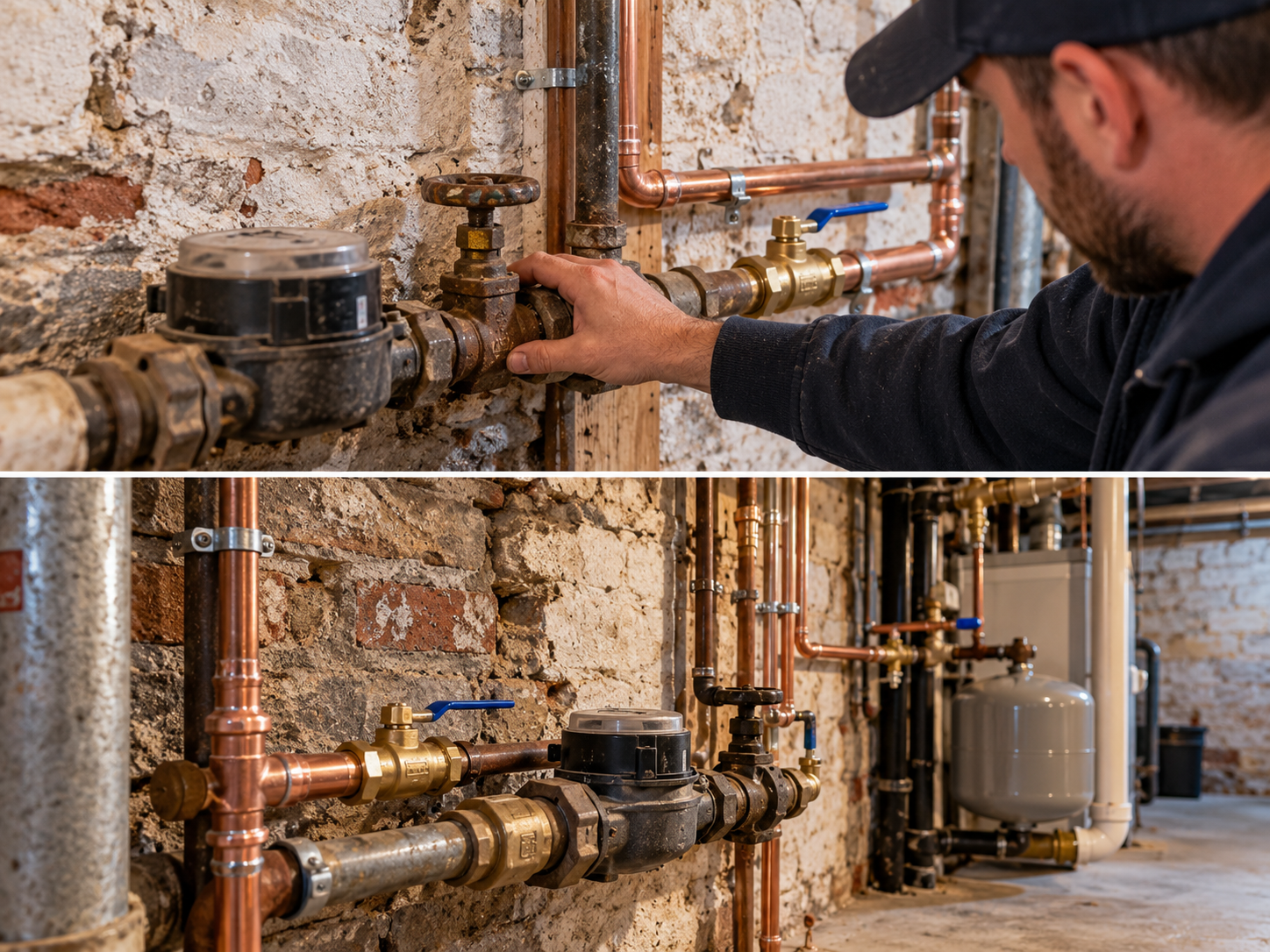
Older Multi-Turn Valves Can Become Difficult to Operate
Traditional gate-style or multi-turn valves contain internal components that can deteriorate over time.
Mineral buildup, corrosion, worn seals, and long periods without operation can make the valve difficult to turn.
Sometimes the handle moves while the internal mechanism no longer closes the water completely.
Other valves begin leaking around the stem after they are operated for the first time in years.
That does not mean homeowners should repeatedly force a stuck valve.
Excessive force can damage aging components.
A Valve That “Mostly” Closes Is Still a Problem
For some plumbing repairs, even a small continued flow can make work difficult.
More importantly, in an emergency involving a broken supply connection or failed fixture, homeowners need confidence that the water can actually be stopped.
A partially functioning valve should be evaluated before it becomes an emergency-only problem.
Modern Quarter-Turn Valves Can Simplify Operation
Many modern shutoff installations use full-port ball valves that operate through a quarter turn.
The simple handle position also makes it easier to see whether the valve is open or closed.
That does not mean every older valve can simply be unscrewed and replaced.
The service material, meter configuration, available pipe length, corrosion, and upstream control all influence the replacement method.
Water Upstream Must Be Controlled
Replacing the building’s main shutoff requires stopping water before the valve.
Depending on the plumbing arrangement, that may require coordination at the service or meter side.
Homeowners should not attempt to manipulate municipal components they are not authorized to operate.
A plumber can determine the correct isolation procedure before cutting into the supply.
Watch for Corrosion Around the Service Entry
The valve itself should not be inspected in isolation.
Nearby piping, unions, meter connections, supports, and transitions may also show deterioration.
If the service pipe is heavily corroded, replacing one valve may expose a broader issue that should be evaluated before the work proceeds.
Label the Main Shutoff After Replacement
A main valve is only useful in an emergency if people know where it is.
After plumbing work is completed, homeowners should make sure adults in the household know the valve location and understand normal operation.
A simple label can help future occupants, maintenance personnel, or contractors identify it quickly.
Test Access Before Finishing a Basement
If a basement renovation is planned, do not hide the main shutoff behind permanent drywall, cabinetry, or other inaccessible finishes.
The valve should remain readily reachable.
This is one of several utility-access questions that should be resolved before basement walls and ceilings are closed.
Professional organizations such as the American Society of Plumbing Engineers publish resources related to plumbing system design and operation.
FAQ
Why won’t my main shutoff close completely?
Internal wear, corrosion, mineral buildup, or a damaged mechanism may prevent full closure.
Can I force a stuck water valve?
Force can damage aging valves or piping. A difficult valve should be evaluated rather than aggressively operated.
Is a quarter-turn valve better?
Ball valves are commonly used because they are simple to operate and provide clear open/closed positioning when properly selected and installed.
Should the main shutoff be replaced during a basement remodel?
If the valve is old or unreliable, remodeling can be a practical time to evaluate it while utilities are accessible.
If your Philadelphia home’s main water valve is difficult to operate or does not fully shut off, address it before the next plumbing emergency makes the decision for you.