
When a tub spout keeps running in shower mode, shower diverter repair can restore flow at the showerhead without replacing the whole fixture. If you’re getting a guest bath ready in Point Breeze, Fishtown, or Manayunk, check the tub and shower before Thanksgiving. A short test can reveal a problem that goes unnoticed when you mainly use the tub.
Philadelphia customers have praised our team for being thorough. On a fixture call, that means taking time to see when and where the water escapes. Start with one observation: Does water come from the spout only while the shower is running, or does it keep dripping after you turn everything off?
When shower diverter repair makes sense
A diverter directs water to the tub spout or the showerhead. On a pull-up spout, the knob lifts a small gate that blocks the tub outlet and sends water upward. On some older three-handle fixtures, the center handle controls a separate diverter inside the wall.
Older Philadelphia rowhome baths often combine original tile and piping with trim added during a later renovation. Parts that look alike from the tub may attach differently behind the trim. Mineral deposits can make a gate stick. A worn seal can also let water pass even when the knob stays in the shower position.
Some models allow a small trickle from the spout during a shower, as Delta Faucet’s diverter guidance explains. Pay attention to a stream that has grown stronger, especially if the spray overhead has weakened. If water keeps dripping long after shutoff, the control valve may not be sealing. That points to a different repair.
What a plumber checks before shower diverter repair
We start by running water in tub mode, then switching to shower mode. Next, we shut the water off and watch where it stops first. That sequence separates a routing problem from a drip caused by the hot and cold control valve.
- Diverter location. A lift knob on the spout and a center handle on the wall point to different parts. We identify the design before recommending a replacement.
- Where water appears. We check the spout mouth, the joint against the tile, and the handle trim. Water at the wall needs a closer look than a trickle into the tub.
- Mounting and pipe condition. We look for a set screw or a threaded connection. If we remove the spout, we inspect the exposed pipe for corrosion, damage, or movement before reusing it.
- How the fixture works after the fix. Photos before, during, and after the work can show the original bypass, the part we reached, and the finished connection. A final test checks both outlets and shutoff.
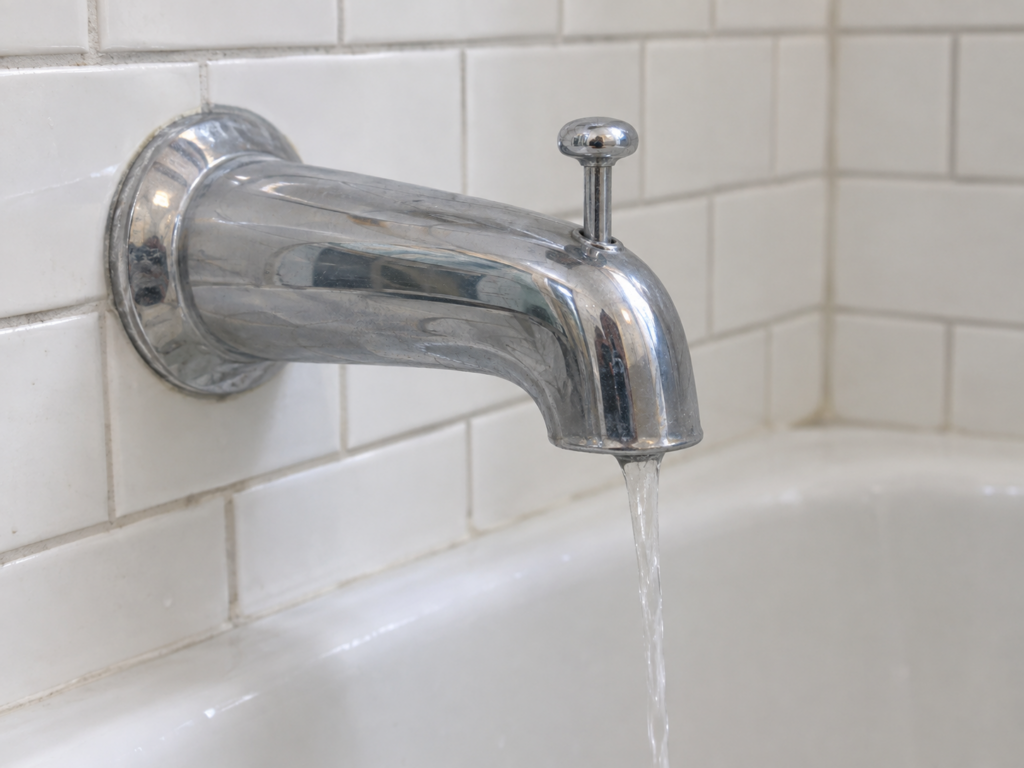
Shower diverter repair or full replacement?
A targeted repair makes sense when the problem is limited to a serviceable part. A compatible diverter stem or cartridge may restore a three-handle fixture if the valve body is sound. On a spout with a serviceable gate, the manufacturer may offer a matching repair kit.
A full replacement makes sense when the failed diverter is sealed into the spout, the spout is cracked, or compatible parts are unavailable. In that case, “full replacement” may mean only the spout assembly. The showerhead and control valve can stay if they work correctly. A plumber needs to match the new spout to the existing pipe and attachment.
Replacing the whole valve is a larger job. It may be necessary if the valve body leaks behind the wall or if a failed valve can no longer be serviced. Ask whether the plumber can use an access panel or open the wall from the room behind the tub. That can be less disruptive than removing old tile.
Warning signs you can spot from the bathroom floor
Stand on a dry floor beside the tub and look at where water leaves the fixture. A strong stream at the tub outlet, a knob that slides back down, or a sudden drop in shower spray are useful clues. A short video showing both outlets can help a plumber understand what happens.
Stop using the fixture if water runs out where the spout meets the wall. The same goes for damp trim, a soft wall, or a new ceiling stain below the bathroom. Don’t force a stuck knob or twist a loose spout. You could move the pipe behind the tile and make the leak harder to reach.
Frequently asked questions
Do I need a new showerhead if the spray is weak? Not necessarily. If the tub spout sends out a strong stream in shower mode, check the diverter before buying a showerhead. If the spout stops and the spray remains weak, the showerhead or another restriction may be at fault.
Why do I get spray overhead while filling the tub? That is the opposite pattern from a tub spout that bypasses in shower mode. A plumber may check for a restriction between the valve and spout, especially after new trim or piping goes in.
Will a spout replacement mean opening the wall? Not usually when the fixture has an accessible external diverter and the pipe behind it is sound. A loose, damaged, or leaking connection may need access from behind the tub.
What should I share when I schedule? Say whether the water escapes in tub mode, shower mode, after shutoff, or at the wall. If you can, take a photo of the spout and all the handles without removing anything.
Get the guest shower ready before Thanksgiving
If your tub spout is stealing flow from the showerhead, Philadelphia Plumbing Experts can help you find the faulty part. Explore our fixture plumbing services or our leak detection and pipe repair services if you see moisture near the wall. Contact us to schedule a visit and tell us where the water comes out. That detail helps us plan the inspection.